
PLAYING SOLITAIRE

solitaire-desktop

Just one more game.  Just until I win two in a row.  These are the thoughts that keep running through my mind as I obsessively play one game after another of Solitaire on my phone.  Or on my tablet. Or my computer.

I start my days so full of purpose, focus; spend time in prayer and meditation, asking God to “teach me to number my days, that I may gain a heart of wisdom” (Ps.90:12). And then I play one game.  And an hour later I’m late getting ready for work; the bed’s not made; and all that spiritual wisdom I tried to assimilate into my day is left in my journal next to my chair.

I have to wonder if this is an intentional sabotage on the part of my addled brain to avoid facing the difficult things in my life, especially these last several years- the death of my parents, my feelings of inadequacy as a wife and mother, my loss of purpose in ministry.  And now my latest hurdle- my cancer diagnosis.

I think back to when I was a pre-teen, in that horribly awkward age of adolescence when I struggled with things like weight, not fitting in, being clumsy.  I suffered with that “first born child” overburdened sense of responsibility.  I always thought that my sisters, just one and two years younger than I was, were closer to each other than to me.  They shared a lot of the same interests, and while they were outside playing and riding bikes, I was inside, pulling out the deck of cards and playing Solitaire the “old fashioned way”- laying those cards out on the bed, in 7 piles, flipping cards 3 at a time.  Was I doing that to avoid solving problems, to keep from looking at my “issues” at 11 years old?  I don’t think it went that deep.  But I do know it gave me some sense of accomplishment if I could win a few games in a row, and improve my time. And it served as an escape for my addict “brain in training”.  Probably healthier than some of the other ways I found to escape dealing with life, later on in college and beyond.

What is it that makes me so fearful, so unwilling to face these challenges of life, even though I claim to be a woman of faith?  I read and claim these promises- that “The Lord is my light and my salvation- whom shall I fear?  The Lord is the stronghold of my life- of whom shall I be afraid?” (Ps 27:1); “I sought the Lord and he answered me; he delivered me from all my fears” (Ps 34:4); “Therefore we will not fear, though the earth give way and the mountains fall into the heart of the sea” (Ps 46:2); “So do not fear, for I am with you; do not be dismayed, for I am your God.  I will strengthen you and help you; I will uphold you with my righteous right hand.” (Isaiah 41:10).

What a beautiful image – that the God of the universe would hold me in His right hand!  How much more comforting are  these words when I let them truly dwell in my heart than the fleeing satisfaction of a few winning games of Solitaire, or the comfort of a pint of ice cream, or the mind-numbing distraction of a few hours of television.  And yet, how often I choose the instant gratification of the flesh over the sometimes painful pruning of my soul.  Even though I know the latter has much more long-lasting results.

I just finished an amazing Bible study called “Finding I Am” by Lysa Terkeurst, and the final chapter about abiding in the True Vine, about the pruning that is necessary to produce more fruit really brought this home for me.  She points out that God isn’t hiding from us- he wants us to know him, so we can more fully abide in him, rely on him for that growth we so often try to produce on our own.

It made me realize that even though I claim to know God, to believe in Him, I still tend to hide from him when it starts to get hard.  When I don’t think I’m ready for the lessons he might be trying to teach me.  Or quite possibly the lessons he wants to teach someone else through my response to difficulty.  Quite honestly, I get fearful that he will use me as some sort of sacrificial lamb, as an “object lesson”- how grandiose of me to think my struggles are that important, that unique!  And so I try to delay the inevitable pruning by playing one more game…

I know that God has given me this desire to write, to share my story in a way that might reach others.  I was recently blessed to share part of my story in church, and I pray that it was able to give hope to some who might be sharing some of the “life on life’s terms” stuff that I have gone through.  I hope I was able to communicate God’s faithfulness through those things, even when I failed to see it in the midst of the storms.  And when I started this blog, it was with the idea of showing how God has brought beauty from ashes- to reveal the redemption that is only possible with him. 

When I used to write in college, in what I consider my Hemmingway “tortured soul” phase, my imagery consisted of things like rusty swings, tear-stained cement walls, dreary pictures that only a soul without faith in any higher power could conjure up.  Now, I delight in things that speak of the great artistry only a powerful God could create- the mighty ocean, colorful sunrises, the variety of birds at my feeder in the morning when I’m reading. 
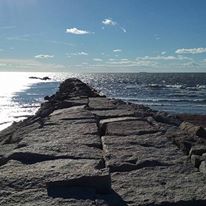
megspoint
Meigs Point, Hammonasset Beach, CT. Photo by PAhlstrand
sunrise
Sunrise from my chair, Photo by PAhlstrand

And so, for today, I am choosing to abide, to allow some pruning by surrendering these current struggles to God without the distractions of mindless games or fleshly comforts.  As I sit in anticipation of the side effects I may have from my first round of chemo, waiting patiently to see if my “time released” medication will start it’s infusion soon, I am choosing, for now, to meditate on the promises that I have found to be true- God says “I will never leave you or forsake you” (Deut. 31:6, Hebrews 13:5); I choose to be amazed by God today, and by his creation, rather than to try and understand why he has chosen to allow yet another struggle in my life.  I am overwhelmed by the thought of him quieting me with his love, rejoicing over me with singing (Zephaniah 3:17), rather than lamenting over my  perceived burdens, throwing poorly attended pity parties.

Will I occasionally fall back into that obsessive behavior of playing game after game of Solitaire, temporarily avoiding the pain of pruning and growing?  Of course I will.  And it may not be so bad to give my tired, overtaxed mind a little break once in a while.  I will still enjoy to escape into a great (or mediocre) piece of fiction, or indulge the guilty pleasure of another season of Dancing with the Stars. 

But when it comes to really facing the trials of life, I have come to believe, in my heart of hearts, that He will be glorified through it all- and that it will be “well with my soul”. 

FINDING MY PURPOSE

PURPOSE

pur·pose, pərpəs/

noun

  1. the reason for which something is done or created or for which something exists.

The age-old question- What is my purpose? Why am I here? About 15 years ago, there was a “movement” in the contemporary Christian community spurred by the publication of Rick Warren’s book The Purpose-Driven Life, which purported to answer the question “What on earth am I here for?” Warren started with the premise that “you didn’t create yourself, so there is no way you can tell yourself what you were created for.”(p. 17)

Armed with the knowledge this book provided, along with the humility, or so I thought, which comes from believing that it’s not all about me, I moved through the next dozen or so years with purpose- I was a wife (maybe the third time’s a charm?), a mother, a lawyer, a student and sometimes teacher of the Bible. I still volunteered at church, was the team mom for baseball, a coach or supporter for other school activities my children participated in. I drove the car pool van, baked the cookies, did the laundry, cleaned the house. During that time I worked as well at various professions-a lawyer, a substitute teacher, a legal assistant, a barista. At one point we moved across the country, and I had the all-important purpose of getting everyone settled into their new environments without giving my own needs a thought-the ever self-sacrificing martyr, doing the right things because, after all, it’s not all about me.

Six years later we moved “back east”, again with a purpose. I thought it was clear why we were coming back – to be closer to family, to help care for my parents, because it was “home”. At first all the “signs” pointed to that being the right decision. Things fell into place- and then they fell out of place. My mother, who was so excited about having all her children close by again, died before I could move back; the house that we thought we had sold in Colorado stayed on the market for a year and a half; the neighborhood we moved back into was far different than when we left. But I pushed on, finding my purpose in the circumstances that remained.

I threw myself into helping my siblings care for my father. We returned to our old church and jumped once again into serving. I thought my mission was to be there for my husband and children, making the clichéd “house into a home”. I took a job designed to provide great satisfaction. And bit by bit everything that gave my life its meaning, those things that I thought I was “created” for, began to slip away. My father died. As challenging as caring for him was, my siblings and I were united in a common purpose, and then it was gone. The church we had invested so much time in, had served selflessly in, crumbled from within, and we had no choice but to leave. My older children no longer needed me as much, not for any reason but they were becoming adults and had to start making their own lives. The job that had been so fulfilling became physically and emotionally exhausting. I found myself floundering, wandering aimlessly from day to day, wondering as I had years ago what on earth I was here for.

I was no longer the responsible eldest child; no longer the revered bible study teacher; no longer the caring, sacrificial mother providing for the physical and emotional needs of her children. I shared with a few close friends that I felt “purposeless”. They nodded in sympathy, perhaps pity. I felt myself entering one of those dark nights of the soul, a place I had been before and had no desire to return to. I started to revisit those feelings that I didn’t matter, I had reached my expiration date.

Dock

I went back and re-read a book I had read a number of years ago when it first came out, “The Fresh Brewed Life” by Nicole Johnson. She, in fact, released an updated version of the first edition after life and its fickleness made her look at her dreams and longings again. So with new eyes I went back and read these words: “Our yearnings, longings, cravings, and hopes are telling us something: there isn’t enough love, peace, hope friendship, and intimacy on this earth to completely satisfy us. We will always want more because we were made for more.” ( p. 39)

Rather than give me comfort those words once again begged the question- what am I here for? What is my purpose? I thought about the idea of dreams and longings, those desires which theoretically lead me to find my purpose. As a little girl, I never dreamed of the white picket fence with a husband and children. I didn’t long for fame and fortune. I can’t even tell you what my dreams were, just that I wanted to fit in and never did. Just empty. Johnson says “The emptiness is the mark and reminder of God”( p. 55); our longings “point the way to God every single time” (p. 57). I spent years trying to fill that emptiness with other things, and thought that some 30 plus years ago, when I put down the alcohol and started my “new” life, that I had gotten a handle on filling this hole with God.

I really thought I had found that purpose that God had for me, that I was being obedient to God’s call on my life, to coin a Christian buzz phrase. But lately I identified more with David in Psalm 38:9-10: All my longings lie open before you, Lord; my sighing is not hidden from you. My heart pounds, my strength fails me; even the light has gone from my eyes.”

How had I gotten here? I thought maybe I just hadn’t found the right “audience”, that my gifts were being wasted on people who didn’t truly appreciate the wisdom my colorful life had afforded me. Yes, loneliness and lack of purpose sometimes lead to arrogance as a defense mechanism.

As is often the case, God uses my arrogance, my brokenness, to teach me. I seem to have been confusing purpose with longings and desires. I’ve been making it all about me, trying to figure things out in my head, trying to force my feelings and desires into some God-given purpose. I read books and devotionals about purpose, calling, obedience. I watch as others claim, mostly in posts on that oh-so-spiritual social media site known as Facebook, that they have found their purpose. I feel stirrings of envy, but then my cynical side cautions against that very human trait of rationalization- taking the ordinary occurrences of life, some which might appear to be timely, and attributing them to a definitive indication of “God’s will”.

I am tearfully preparing to bring my youngest child to college 1700 miles away from home. My mind races, as it did with my older children, with thoughts of whether I’ve done enough to prepare him, the all-powerful “me”. And of course there’s that fear of loss of purpose, of no longer being needed. What will happen now that there’s no one in the house except me and Dave? How will I fill my time? How will I measure my usefulness? My anxiety rises as I spend all this time in my head, a practice, as I was told long ago, was a sick mind analyzing a sick mind- not at all productive, and certainly not one which leads to any peace or serenity.

Mary DeMuth, in her book Everything, reminds me that “This world doesn’t covet our intelligence. It doesn’t need our wit or wherewithal. It has no use for our coy phraseologies. It needs Jesus- full of outrageous grace, unconditional love, and hope-filled pardon.” And that thought smacks me back to where I need to be. I did not create myself, I am not the answer. I am merely a vessel. If I allow myself to be filled to overflowing with that grace, love and hope, it can’t help but overflow to those around me.

When I can stop my racing mind long enough to reflect on what I know to be true, what I have learned through this turbulent yet joyful journey called life, I know deep in my heart that I have one purpose: “To do justly, love mercy, and walk humbly with my God” (Micah 6:8). All my desires and longings flow from that.

Micah6

SOME THOUGHTS ON GOING


I am not one to believe in coincidences.  “Coincidence” is defined as a “striking occurrence of two or more events at one time apparently by mere chance” (dictionary.com).  It is hard to reconcile this idea of mere luck or chance with my belief in a God who has “authority over all things in heaven and on earth”.  I don’t want to imply that God is a grand puppeteer, though, who pulls the strings on each and every breath I take and every decision I make.  He has given me free will, the ability to choose a path, sometimes daily.

I also do not like the idea of jumping on the “new year” bandwagon- being one of the many posting about how I will approach the upcoming year, full of well-meaning resolutions and commitments to live a healthier, more significant life.  But when the same theme or verse comes up more than once or twice in the various readings I do on a daily basis, I do think the God who has authority over heaven and earth might be trying to get my attention, intending to give me some direction as to which path I should choose.  That it happened to occur on the first few days of a new year, perhaps that is the “coincidence”.

What is that word or theme that keeps coming up?  It’s “GO”- GO, even though you don’t know where you’re going (Hebrews 11:8); “GO and make disciples…” (Matthew 28:18-20); to go “unashamedly” (Phil. 1:20).  Now, I don’t believe I’m supposed to pack my belongings and head out for parts unknown in my little Miata (some might suggest that my shoe collection would take up most of the trunk!), but I do believe there are other ways of “going” without ever leaving this chair at my dining room table.  So as self-serving as it may seem to some, I will “go” by writing, by sharing how that God with authority over heaven and earth has changed my life, and has brought me to the place where I am today.  And perhaps the result of this small step in obedience is that someone else will also be challenged to go, to follow where God may be leading them.

When I really think about the reason I started this blog, and this whole idea of “redemption”, of going from ashes to beauty, I need to acknowledge what God has given me to accomplish what I believe is His purpose for my life.  All I have is just that-my life, and the experiences and decisions, good and bad, which have led me to this place.  So by sharing just a little of that story with each post, perhaps I can encourage you that God has a purpose for you as well; that your struggles and sufferings are not in vain; that they are not wasted time, but “challenges and opportunities”.  I have come to understand that if I am to go unashamedly and make disciples then I must tell others what my life was like before and after I gave God authority over that life.

So where to start?  I have some photographs of myself as a child which I keep in the front of one of my devotional books.  It was a suggestion by a woman we called “Lady Mike” over 30 years ago when I was beginning my struggle for sobriety in church basements in Northern New Jersey.  She wasn’t promoting the then-popular Bradshaw movement of reclaiming the “child within”, but rather encouraging us to treat ourselves gently, as we would a young child, a child with innocence yet unaffected by heartaches and poor choices. I look at those photos almost every day and try to recall what that little girl was thinking, how she felt at the moment the camera lens snapped that picture.pammy2

Although I may recall many of the life events from my childhood, I really have a hard time getting a handle on the feelings surrounding those events, other than the feeling of shame, of not being “good enough”.  I have come to learn that no one is to blame for these feelings; I wasn’t “shamed” into things, or made to feel less than.  It seems, rather, that those feelings came about as a result of spending many years trying to achieve the unattainable goal of perfection, or at least acceptance.  The problem with that is the standard I was trying to meet was not the one set by God, who has authority over everything, but by man- not one specific “man”, but just humankind in general.  There were the rules of the church I grew up in, put in place mainly to give a sense of order to worship; there were the rules my parents established, created lovingly for my protection, for the most part; there were rules in school, in the workplace, in social settings, in marriage.  None of them made complete sense, and certainly no one could keep them all.  And so the result was shame, a sense of failure, the feeling of never measuring up.

I remember first feeling that way when I was in the 6th grade, caught in that awful time in between childhood and adolescence, with the chubbiness that often accompanies puberty.  I was never really thin, but now I had “crossed over” into overweight.  My father made a deal with me-if I could get my weight under 100 lbs., I could have anything (within reason) that I wanted!  Music was a huge part of my life, an escape from reality.  It afforded a wonderful trip into a world where I could woo crowds with my sultry renditions of love songs like Patti Page and Nancy Wilson.  So I decided my reward for this great achievement would be a stereo.  I still remember the day that I got on that scale and it read “98 lbs.”  I immediately called my father at work and announced that I had done it!  I had achieved the goal that had been set, that arbitrary number that somehow made me worthwhile, and I was to be rewarded.  My dad happily brought home that stereo that very night, and life was wonderful.  I was no longer ashamed of my appearance.Pammy1

Of course, my sense of accomplishment was short-lived.  There is no way to maintain that feeling of victory, of self-worth, when we are trying desperately to meet standards set by man by using self-will and perseverance, attributes which I was taught were the bedrock for success.  We moved from the city of Teaneck, where I had spent all my life to that point, into the woods of Pennsylvania- a lake community in the little town of Pocono Lake, 20 miles from the nearest school, with only one other family living there year-round.  I had absolutely no skills in the arena of making friends, had no real athletic or artistic abilities which might help me connect with a certain group, and was one of those unfortunate pre-teens who “developed” earlier than others.   I spent those two years in Pennsylvania feeling like an outcast, an afterthought, not really knowing where I fit in.  I loved going for walks up along the top of the little ski slope in our community, along the ridge where old stone walls had once stood, imagining who might have lived there, creating romantic stories of worlds where everyone was loved and accepted.  I had my first job in that little community, working at a snack shop called “The Chipmunk Snack Bar”.  At 12 or 13 years old, I felt a little important that I could run a cash register and serve hot dogs to the summer visitors.  But then we moved again, this time to Sussex County, New Jersey.  And I began that life-defining journey known as high school. 

So, you might ask, where was God in all of this?  Where did the One who has authority over heaven and earth fit in my view of things?  He was always a presence, but not one which I acknowledged with reverence or admiration.  He was certainly mentioned often, especially by my mother, who had a deep faith in all things “holy”.  She regularly gave God the credit for many “miracles” in her life; it was God that blessed her with her family, her children, her home.  She was not ashamed to use His name, and we were all raised in church every week, both on Sunday and in weekly catechism classes.  We observed the holy days, and took part in all the sacraments.  If we forgot our chapel veils on Sunday morning, she would always be prepared with Kleenex and bobby pins, affixing them to our heads so we wouldn’t enter God’s house showing any irreverence. 

I followed the rules out of a vague sense of obedience, because I wanted to gain approval from my parents, or from the power or powers that be.  But in high school I began to question the validity of these rules.  I started to see my mother and others who had faith such as hers as weaker than those who operated on intellect and will power.  And, of course, I wanted to be a part of that stronger, more “successful” group.  The educated elite.  And so God was dismissed as fantasy, as not having any connection to a successful, productive life.  And my journey into the pit, that place of “ashes”, began. 


FIRST IMPRESSIONS – AND THEN SOME

I first posted this almost 10 years ago, prompted by a text from a friend reminding me of our first meeting. I met that same friend for lunch last week, now 46+ years after we first met. Before we met I went back and read the original post. Looking back over the past 10 years, so much has changed, and yet some things remain the same. That friend and I, who shared the joys of weddings and parenthood; the loss of parents and other loved ones, now exchange photos and stories of grandchildren. We talked about the friendships that endure, in spite of the differences of opinion we may have over current events. And we’re grateful for the continued connection.

I am amazed by the fact that so much of this post still remains true. Some of those relationships have faded away, unintentionally or maybe just through the natural attrition that takes place as we age and our priorities change; some of those friendships are still intact, and it seems that one consistent factor in those long-standing relationships is the reciprocal caring and support which exists regardless of what some may perceive as “divisive” issues.

I have moved multiple times since this first post, and I find I am still attentive to those “first impressions” when moving into a new area. And I believe I still pay attention to those “parting ” scenes. Most importantly, I would like to think I’m a bit more intentional about the time spent in between the two.

Having just entered my 70th year of life (I turned 69 a few weeks ago), I am grateful that I have not succumbed too often to those periodic bouts of isolationism that my pride and misguided self-reliance make me prone to. It’s not always easy to do; sometimes I just get weary or maybe lazy. But I know it’s always worth it.

LessonsLearned

I received a text from a friend a few weeks ago. It simply said “I met you 36 years ago today”. It made me smile. It also made me think about the circumstances of that meeting, and wonder how many other “first meetings” I could recall.

In her book “The Friendships of Women”, Dee Brestin speaks several times about what she calls ”greeting scenes”:

“By greeting scenes, I mean the sensitivity to realize, on meeting someone, that God may be involved….How sensitive are you to those you meet for the first time? Do you ask, when you meet them, whether it could be that God has a reason for bringing this person across your path?” (Friendships, p. 160).

I remember going through this particular book in a bible study group, and my dear friend Catherine being able to recount the exact time and place of our first meeting. She has now passed away, and her sensitivity to those “greeting scenes” is one of many pearls of wisdom which I gleaned from our friendship. It caused me to reflect on some other “greeting scenes” I had experienced, and I found that the ones I recalled most clearly, which left the greatest impact, often led to the deepest friendships. There was the woman in the yellow rain slicker who was rocking in her chair, unable to look anyone in the eye or really speak who, 29 years later, is one of my closest confidants. When a mutual friend suggested we take her for coffee, my response was a less than compassionate “Why would we do that?” Fortunately, my wiser, more compassionate, friend was more sensitive to God’s leading than I was.

A few years ago we returned to the Northeast, after spending 6 years living “out west”. I came back into a whirlwind of family circumstances which took a lot of my attention, and making new friends wasn’t really on my radar. I do recall, however, meeting a woman at church for the first time. She had moved to the area in my absence, and had established herself firmly in some of the ministries at church. My “first impression” of her was that she was attractive, friendly, had a sweet southern accent, liked shopping and Starbucks, and I wanted her to like me. Like an awkward schoolgirl, I wanted to be her friend. We have since become friends, not at all in the way I had planned, and I have no idea if she has any recollection of our first meeting. We have never gone shopping or to Starbucks together, and yet it has become clear that God had a reason for our paths to cross.

Often times, however, those paths seem to cross only for a brief time. Sometimes we don’t understand why certain friendships end like they do, or when they do. Some come to a natural or anticipated end due to a move or job change; others may end with a clear parting of the ways because of a disagreement that can’t be reconciled. But more often than not they just fade away slowly, without any apparent cause, and before we even realize it. In those instances when a move or other major change is affecting the dynamics of a friendship, Brestin says it is just as important to pay attention to “parting scenes” as it is to “greeting scenes”.

I think about some of the significant “parting scenes” in my life-mostly times when, as an adult, I have made a major move from one part of the country to another. There were parting gifts- a handmade quilt signed by all the ladies in my Bible study group, a box of handmade chocolates to make the drive more bearable; there was friendship shown in an unusual yet meaningful way- the friend who spent a day cleaning my oven, the one who kept my home vacuumed for real estate showings; there were hugs and tears and promises to stay close. I would venture to say they were done well, and there have been similar scenes which I have helped script for departing friends. I was blessed to be a part of one of those emotional send-offs just last week. But what about those less dramatic “parting scenes”?

20151204_213536

There is a scene from the movie Boys on the Side that breaks my heart every time I see it. The two characters aren’t talking about friendship, but I think the principle is the same:

Jane: Do you miss it?
Robin: What?
Jane: Sex.
Robin: Yeah, I do… You know what’s weird? You never know the last time you sleep with somebody it’s the last time. You’re thinking: “Oh, we got problems, we got work to do,” you know, but you never think… and then you break up and a month later you look back and you go: “Oh, that was it.” That Tuesday or Friday or whenever, and you wished you paid attention because it was the last time… Well.

Isn’t it that way with those friendships that kind of just fade away? You don’t even realize they’ve ended because you’re not really paying attention. And then you find yourself lonely, wishing for someone to go shopping with or to sit at Starbucks with for just an hour. And you wonder what’s wrong with you that you don’t have friends.

What is it that instills in us that desire to be liked, to be friends with certain people that we still, even as “seasoned” adults, perceive as the “popular kids”? It is one thing to recognize the desire placed in each one of us for friendship. That is, I really believe, placed there by God, and demonstrated over and over again in scripture. We are told to love one another, to encourage one another and build one another up; to admonish one another, but with gentleness; to think of others better than ourselves. We are clearly made to live in fellowship, not in isolation.

But what is it in us that takes that natural, God-instilled desire for fellowship and perverts it to one extreme or the other: Either we convince ourselves there is something terribly wrong with us for not having those friendships that movies are made of, or we protect ourselves from hurt and abandonment by proudly taking on a “lone wolf” persona, neither of which achieve that “one another” mindset God intended for us.

As I move through what is likely the final third of my life here on earth, I have predictably become more reflective about time well-spent and time wasted. I’m not sure what it is that stirs up that desperate feeling of loneliness from time to time, or what makes me have those days when I choose not to answer the phone or leave the house. But I do know that is not the best use of the time I have been so graciously given.

So I will try to be more intentional about both those “greeting scenes” and “parting scenes”, as well as those moments in between, those cups of coffee at my dining room table; I will ask myself “what is God’s purpose for bringing this person across my path today”, rather than questioning whether there is a reason or seeing it as a nuisance, an interruption to my plans; I will pay attention to those friendships that seem to be slipping away, and make every effort not to be the one guilty of abandoning them. I will ask God “to teach me to number my days, so I may gain a heart of wisdom” (Ps. 90:12). I will see it as a true blessing when a friend sends me an urgent Facebook message asking me to pray about something, or sends me a text after 36 years. Perhaps I will come to really believe that it’s not about me, but about being “bound together in peace”, about loving one another as we have been loved by God, about being so filled with that spiritual joy which is promised (John 15:11) that the joy will overflow.

REDEMPTION

The concept and name of a blog came to me long before I had any idea what it meant to be a “blogger”, or how to go about setting one up. After I begged my much more tech-savvy twenty-something daughter to give me a brief tutorial, I thought I was on my way.
More than 6 months later, all that exists is the name, and this one word that has been ruminating around in my mind for the last 27 years, desperately trying to find its way to paper. Or at least to the page, 2015 style.
Redemption. Delivered from a life of pride and arrogance, of self-sufficiency and disrespect, to a state of total dependence.
Redemption. Rescued from the pit of addiction, dishonesty, shame, widowhood, bankruptcy. Truly taken from “ashes to beauty”.
“To all who mourn…He will give a crown of beauty for ashes, a joyous blessing instead of mourning, festive praise instead of despair. In their righteousness they will be like great oaks that the Lord has planted for His own glory.” (Isaiah 61:3, NLT)
Several years ago, my husband and I were part of a church in Colorado where we served as small group “facilitators”, hosting couples in our home for Bible study and fellowship. To prepare us for this role, we went through a class with other potential leaders. At the end of the training, the teachers performed a foot-washing. Having gotten to know each of us throughout the class, they prepared a verse to share as they washed our feet which was pertinent to our individual testimonies. This verse from Isaiah was the one given to me by that dear woman who taught me how important it was to be intentional in relationships.
I don’t intend this to be a place of complaining about circumstances, a place of “woe is me! Look what I’ve been through!” but rather a place of encouragement, a place of look what I’ve gotten through! I don’t share struggles or challenges as a way of comparison or “one-upmanship”; I have learned through the last two and half decades that often we go through difficulties for no other apparent reason than to offer comfort to others. It is my hope that my words will, in fact, serve as an “oak”-a place of safety and shade for those who may be questioning their purpose or wondering about the reason for certain situations in their life; a place of redemption stories, where joy and blessing become the focus rather than despair.
If I speak of difficult things or of subject matter that may be uncomfortable, it is only to shine a light on the Redeemer who has taken me from mourning to rejoicing, from despair to praise, from ashes to beauty. Be encouraged!
“I want them to be encouraged and knit together by strong ties of love. I want them to have complete confidence that they understand God’s mysterious plan, which is Christ himself.” (Col. 2:2)